On Music: The Soundtrack to a Life
I stop and think when I hear someone say they don’t care much for music. To me, this seems almost tantamount to not finding much humour in a perfectly timed, brilliantly delivered joke that has everyone doubled over with laughter. An old friend once told me he never listened to music, and struggled to name more than a few modern mainstream artists. This perplexed me, and not because I was some pretentious music connoisseur, far from it, and definitely not someone who would play songs from the Beatles’ White Album in reverse to try and decipher hidden satanic messages; that, I think, would be indulging in music a little too much.
It was because certain types of music — chord sequences, melodies and layers of sound — can, for me, carry a surprising amount of meaning when immersed in. Surprising, perhaps, because many of those songs are musically rather simple. The qualities that connect the songs that truly stay with me are nostalgia, hope, melancholy, and what I can only describe as youthful, carefree exhilaration. If a song somehow manages to lie at the centre of this Venn diagram, then it is basically guaranteed to become a lifelong listen.
Then again, it could also just be a song that goes incredibly hard with very little substance, the sort of thing that exists primarily to be played at 1 a.m. in a Leamington Spa nightclub. Music with a rough edge, a solid rock beat, modal complexity of the sort Rick Beato would approve of, and huge vocals can be just as inexplicably great, and the same goes for the juxtaposition of Dua Lipa and Chopin. Music doesn’t have to produce some profound emotional response as a prerequisite for enjoyment; sometimes, a song can just be a superficial banger in that sense.
But it is the earlier theme that I want to explore here through my own experience: when music means something deeper. (Writing about every band, artist and song which I love would be a whole PhD thesis in itself, but see Honourable mentions at the bottom of this page for a sample).
Oh to be young! — Oasis and High Flying Birds
Few bands have exerted such an enormous influence on my teenage years and early twenties as Oasis and Noel Gallagher’s High Flying Birds. When I first picked up an acoustic guitar at the age of 15, you can bet that Wonderwall was the first song I learnt. Before long, Slide Away, Morning Glory and a growing collection of B-sides like Talk Tonight, Half the World Away, and plenty more, had found their way into my repertoire.
It has been more than a decade since I first discovered Oasis, and I was hooked almost immediately. There was something irresistible about their swagger, their effortless cool and their enormous rock-n-roll sound. They seemed to inhabit a world in which everything was louder, brasher and considerably more exciting than the one I had known from Coldplay (I adore Coldplay don't get me wrong). I was less enamoured, perhaps, with the Brothers’ famously repulsive Mancunian personalities, although Noel, as I will come to later, aged like a well-cellared wine. Oasis embodies almost perfectly what I described earlier as “youthful, carefree exhilaration”. Their music carries the feeling of being young and invincible, of walking down the street with absolutely no reason to believe that the world might not belong to you.
D’You Know What I Mean? — unrelated, but a stock phrase of Liam — was, and remains, firmly in my top three favourite songs. There is something about the layers of noisy, gritty guitars, so characteristic of the Be Here Now album, Liam’s enormous vocals and Noel’s guitar solo that still hits me in the chest, even after all these years. The song takes me straight back to being seventeen: playing competitive cricket every week, exploring my slightly rebellious side through alcohol, and gradually discovering a new confidence, one apparently bestowed upon me by the Oasis Gods.
TBC
I'm lost in Australia — Old Mervs
My Apple Music has been inundated with the sounds of sun-soaked, infectious Aussie indie bands for the better part of two years now. Old Mervs are one of those very niche bands, and have risen, without question, to the number one spot in my charts. They are a two-piece whose music straddles buoyant Britpop and the grittier terrain of ’90s grunge, with guitar lines that, to me, evoke the same feelings I get from a lot of Oasis and Noel Gallagher’s HFB records — which, I suppose, is hardly a coincidence. Their song Give It Up, from the EP of the same name, is somewhat introspective and faintly troubled, yet its sound is anthemic, building towards an almost euphoric outro, as though the song has decided to forgive itself. I would go as far as to say it epitomises what Old Mervs are about for me.
The first song I heard from them was Hey, which immediately screamed ’90s. The Coldplay-esque bridge, at least to my ears, was the initial hook. But it was ultimately the acoustic guitar and soaring vocals that cemented this song as a fixture of my first year and the first half of my second year at Oxford. Moving to Oxford in 2023 brought with it a maelstrom of excitement, trepidation, curiosity and unbounded opportunity; studying there had been a six-year-long dream of mine. I found myself surrounded by people with incredible intelligence and humour, with whom I shared some defining memories, and made for a formative time — one that I remember fondly.
Old Mervs, with their moments of unbridled joy and upbeat melodies tempered by melancholic and nostalgic undertones, seem to write that story for me, not always in their lyrics, necessarily; rather, it emerges somewhere in the space between the propulsive drumbeats, the echoed guitar and the outstretched vocals. Now, as I start my fourth year, the associations I have with these songs have shifted again. They have come to hold new people, new love, new experiences, and fragments of time that would otherwise have been too ordinary to remember.
Why the unassuming sound of an Australian two-piece instils such a profound sense of comfort in me... I don't really know, but I have some theories (that's another topic for a blog on the science of music and the brain). Perhaps you would listen to their songs and find them a little too thick with nostalgia, or even rather sad, particularly if you are inclined to listen to lyrics before melodies. I tend to do the opposite, or some superposition. There's no right or wrong. Whether I like it or not, these songs continue to be played on a daily basis. They have carved out their territory in the timeline.
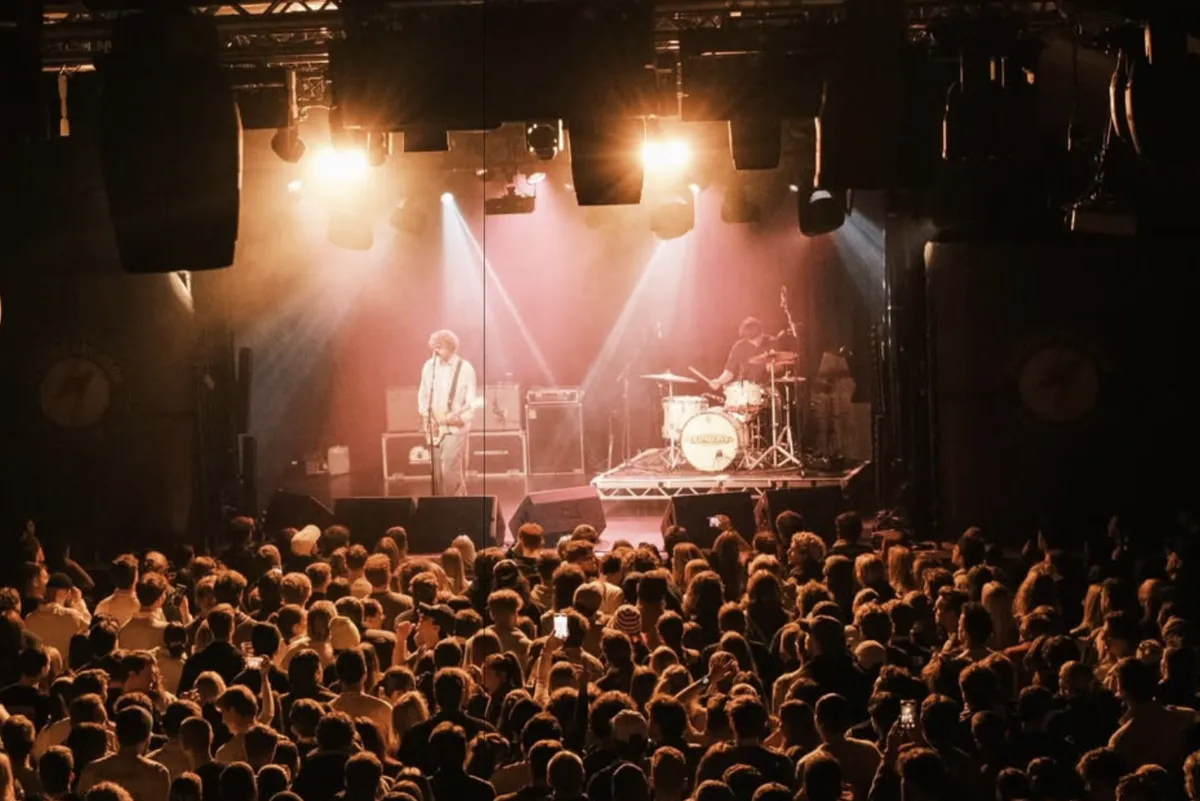
In December 2025 (start of third year) I went to see Old Mervs in Camden Town with my girlfriend. It was pure luck that I had stumbled upon their European tour a few days before. It was a great night, full of banging tunes (and mullets and moustaches). Earlier this year, I walked into an independent coffee shop on Oxford High Street to order the obligatory Mocha, and the barista looked surprised when she saw my T-shirt with Old Mervs written on it. She then told me how incredibly niche my taste is, so much so I felt a small sense of judgment from her expression. I was more surprised than her, though; I was convinced up to that point I was the only person in Oxfordshire (at least) who had heard of them. I continue my quest to seek out more hidden indie gems.
A Guitar That Sings — Pink Floyd
Honourable mentions
In no particular order:
- Coldplay
- Bastille
- Sting (and the Police)
- Sam Fender
- The Beatles
- Deacon Blue
- David Bowie
- Billy Joel
- Bruce Hornsby and the Range
- The Verve
- Led Zeppelin
- The Cure
- John Mayer
- Kasabian
- KT Tunstall
- Dire Straits
- Electric Light Orchestra
- Jimi Hendrix
- Foo Fighters
- Hozier
- The Fray
- Leddra Chapman
- Ludovico Einaudi
- Metallica
- The Smiths
- Nick Cave & The Bad Seeds
- Red Hot Chilli Peppers
- Richard Ashcroft
- Steve Winwood
- Tame Impala
- U2
- The 1975
- definitely not Blur
- most ’80s dance songs
- a lot of pop girl stuff (admit you like it too!)
There are simply too many standalone songs from artists/bands I like to name them all.